The Standard Deviation
Standard Deviation: Reversing the squaring math to return to real-world units and create a universal scale for measuring data fluctuations.
Imagine you are a financial analyst monitoring market prices for a massive trading firm. You calculate the Variance of the prices to see how volatile the market has been. The math gives you a Variance of 2,500.
You present this to the board: "Our price variance is 2,500 Egyptian Pounds squared."
The directors stare at you in confusion. "What is a squared pound? Do we buy bread with 2D currency boxes?"
By squaring the distances to prevent negative values from canceling each other out (as we learned in Variance), you mathematically broke the units of measurement. You cannot easily report "Squared Pounds" or "Squared Liters." You need a tool to compress the Variance back down into reality.
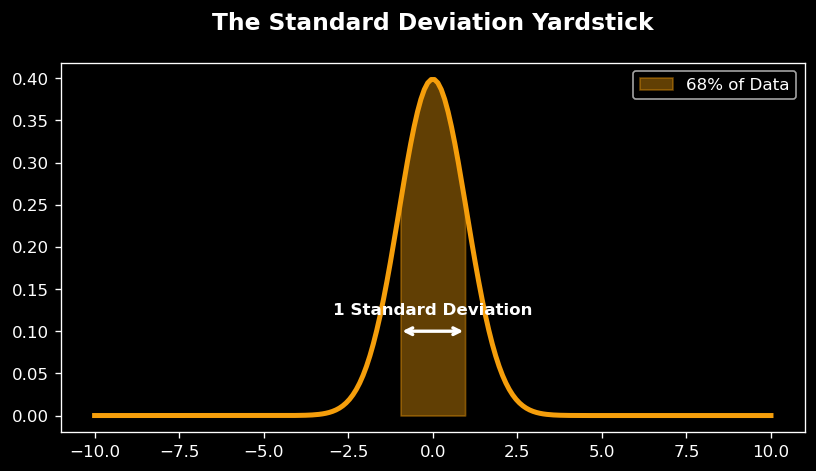
The Standard Deviation is the universal yardstick of data science. It is exactly what its name implies: the "Standard" amount that data "Deviates" (moves away) from the Mean.
Mechanically, it is incredibly simple: Standard Deviation is the Square Root of the Variance.
By taking the square root, we reverse the squaring process we did during the Variance calculation. The result of 2,500 squared pounds becomes a Standard Deviation of 50 EGP. Now, you can confidently report: "Prices fluctuate by about 50 EGP on average." This is clear and actionable information.
In Python, there are two professional ways to calculate a square root. Choosing the right one depends on your project's architecture.
# Method 1: The Exponent Trick (Zero Imports)
variance = 2500
std_dev_direct = variance ** 0.5

# Method 2: The standard math Library
import math
std_dev_lib = math.sqrt(variance)

print("Standard Deviation:", std_dev_lib)
Raising a number to the power of 0.5 is identical to taking its square root. This trick requires zero libraries, keeping your code lightweight.
Math has a strict rule: you cannot take the square root of a negative number using real numbers. If your variance logic is flawed and produces a negative number, Python will halt your execution.
Running math.sqrt(-100) raises a ValueError. Professional analysts use Defensive Programming by ensuring the input is positive using abs() before the root calculation.
You must build a reusable function that calculates the Standard Deviation safely for any market data stream.
import math

def get_standard_deviation(variance_input):
    # Defensive gate: Force positive value
    safe_val = abs(variance_input)

    # Calculation
    return math.sqrt(safe_val)

market_variance = 2500
print("Safe SD Result:", get_standard_deviation(market_variance))
- Variance uses "Squared Units" which are hard to explain in business reports.
- Standard Deviation is the square root of Variance, returning results to original units.
- In Python, use ** 0.5 or math.sqrt() for the calculation.
- Always use abs() defensively to prevent math errors with negative inputs.